
By Hazel Scott/ASU
Alabama State University (ASU) and Morris Brown College (MBC), a historically black institution in Atlanta, Georgia, signed a Memorandum of Understanding on Tuesday, June 16, to smooth the path from an undergraduate (bachelor’s) degree at Morris Brown College to a graduate degree at Alabama State University.
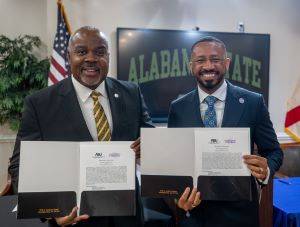
ASU President, Dr. Quinton T. Ross, Jr., and Morris Brown President, Dr. Kevin E. James, signed the agreement during a ceremony on ASU’s campus. Others participating in the ceremony were Dr. Carl Pettis, ASU provost and vice president of Academic Affairs; Dr. Jamie Jamison, provost and senior vice president for Academic Affairs at MBC; Dr. Anthony Broughton, dean of ASU’s College of Education; and other representatives from both institutions.
Through this partnership, ASU and MBC reaffirm their shared mission to expand educational access and equip students with the skills and credentials needed for successful careers.
“This historic collaboration is a testament to the commitment of both institutions in fostering educational opportunities and supporting student success,” Ross stressed. “To students of Morris Brown College, I want you to know that we are prepared to receive you, we are prepared to make room for your greatness, we are prepared to support your aspirations, and we are prepared to help you continue your path to educational and professional excellence.”
James echoed Ross’s sentiments, expressing his enthusiasm for the partnership.
“I’m so excited to partner with Alabama State University today to provide access and opportunity for our graduates to attend Alabama State for graduate studies. Just a month ago, Morris College graduated its largest class in over 25 years -- 93 graduates -- and we want to send them to Alabama State for grad school. We thank you for this opportunity for our students,” James emphasized.
Through the alliance, eligible candidates from Morris Brown College, which primarily offers undergraduate programs, receive a streamlined pipeline into ASU’s distinct master’s programs in the College of Education, including master’s degree programs in a variety of fields (business, cybersecurity, data analytics, healthcare administration, management, information technology and biotechnology). ASU has 13 key online master’s programs, including rehabilitation counseling, accountancy, social work, forensic science, and health counseling.
Many of the programs also offer “Alternative A” (alternative certification) pathways for students seeking certification who did not complete an undergraduate teacher preparation program.
Traditional pathways are also available.
“What’s attractive about the partnership is that ASU has in-person and online options…This gives our students access and opportunities to complete their graduate degrees. Once we looked online at the program offerings, many of those offerings are direct pathways for our graduates in business, psychology and music alike,” James added.
Broughton emphasized the impact the partnership will have on future educators.
“This partnership between ASU and MBC share a mission to remove barriers so that students can have the best access to quality education. Since 1867, ASU has been committed to providing transformational opportunities for the community and beyond. Today marks a shared commitment to foster optimal opportunities for our scholars, to foster robust institutional partnerships and to provide powerful pathways for educational advancement,” Broughton said.
Historically Black colleges and universities, Ross noted, have long worked together to create opportunities that transform lives and strengthen communities.
“We look forward to a future marked with education excellence, collaboration and student success,” Ross emphasized. “This agreement ensures that the rich heritage of our educational institutions is not only protected but elevated for modern scholars. This signing today, reaffirms when historically Black colleges and universities work together, our students, community and our nation are stronger because of it. When we unite, we multiply opportunities, expand possibilities and build legacies that will impact generations to come.”