
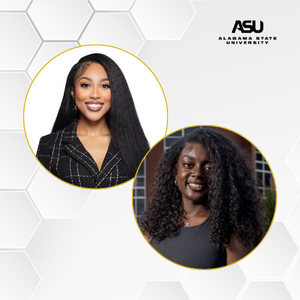
By Hazel Scott/ASU
When Alabama State University seniors, Nyla Clark-Smith and Amia Carter, stepped into the bustling heart of Washington, D.C., their destination was the Newhouse DC Center, a hub buzzing with innovation and creativity. Selected to represent their University, the two communication majors joined other talented HBCU students at the esteemed HBCU Immersion Program hosted by Syracuse University’s S.I. Newhouse School of Public Communications.
This unique experience aimed to bridge the gap between strong academic foundations at Historically Black Colleges and Universities (HBCUs) and the dynamic world of media innovation.
Dr. Rockell Brown Burton, dean of ASU’s College of Liberal Arts and Social Sciences, knows the power of education firsthand. Burton, reflecting on her journey as a two-time graduate of Historically Black Colleges and Universities (HBCUs), said she knows firsthand the strengths and challenges these institutions face.
“Although HBCUs provide excellent education, they often lack resources to give students meaningful hands-on experiences and professional networks that others might easily access,” she stressed.
Determined to change this, Dr. Burton, then the associate dean for Diversity, Equity, Inclusion, and Accessibility at Syracuse University’s Newhouse School, envisioned a program to bridge this gap. She created the HBCU Immersion Program—designed not just to share information but to offer students a real, immersive experience in media communication.
“The goal was to open pathways for talented HBCU students to engage with new environments, build lasting connections, and prepare for advanced graduate studies,” she said.
Clark-Smith and Carter had that chance over two days to step into a vibrant world of media communication, tapping into the vast network. They met peers chasing similar dreams, took part in hands-on projects, and glimpsed what graduate school at Newhouse could offer.
They explored cutting-edge technologies and bold ideas shaping the future of communication. They visited thriving startups and technology giants, meeting founders who brought the latest advances in artificial intelligence and digital media to life. Workshops gave them hands-on experience creating digital content.
Burton noted that for Clark-Smith and Carter, their experience was more than just a brief visit; it was a glimpse into their own futures as creators and strategists shaping the stories of tomorrow.
“Like Clark-Smith and Carter, each year students return to their campuses with stories to tell—stories of inspiration, challenge, and growth. They share how the experience affirmed their talents and opened their eyes to opportunities they had never imagined,” added Burton. “They lend their voices to encourage other students and motivate themselves and feel affirmed, validated and reassured that they are ready to compete.”