
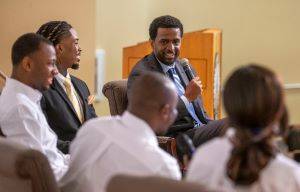
By Hazel Scott/ASU
On Thursday, February 19, the historic DeShields Auditorium at Alabama State University filled with eager faces—students, professors, and community members—gathered to hear Bakari Sellers, a son of the Civil Rights Movement and a voice for today’s struggles.
Raised in rural South Carolina by an activist father, Cleveland Sellers, who was involved in the Student Nonviolent Coordinating Committee during the turbulent 1960s, Sellers grew up listening to tales of courage, pain and hope. His father’s stories about sacrifice during the Orangeburg Massacre and the long struggle finally reached their peak. But Sellers warned, “We’re not at the mountain top yet.” He stated that the fight for integration was only the beginning.
“Our goal has shifted,” he said, “from integration to power — economic, political, and community power.” He challenged everyone to understand that true change requires more than election-day visits to churches; transformation demands consistent, year-round effort to rebuild neglected communities, fix broken schools, and ensure safe, clean living conditions.
Sellers’s discussion reflected the steadfast hope in faith, family, and unwavering activism. “I’m reminded that when we, African-Americans, first got here all we had was our hope and faith; however, understanding that challenge with some type of urgency gives me hope. These types of institutions (HBCUs) bring you hope. Black folks in this country are often reduced to their hope and faith.”
Sellers advocated for bringing one’s full, authentic self to every table, conversation, and professional environment, arguing that attempting to be someone else has no inherent value. As a young Black Democrat in South Carolina, Sellers experienced intense pressure to conform but instead he said chose to remain true to his upbringing and identity rather than changing who he was. His advice to the younger generation is “drive social change without sacrificing your identity.”
“The younger generation, using social media as their new battleground, channels the spirit of their forebears but faces fresh challenges and deep anxieties. I urge them to be change agents — to show up, speak out, and bring their whole authentic selves to every conversation. You don’t have to be someone else,” he said with conviction. “Unapologetically bring your full selves to the table. Authenticity is essential for effective leadership. That is how we crack the system.”
Sellers emphasized that the work of civil rights and the work of justice have changed from one generation to the next.
“Our paths, I know that President Ross agrees, is to lower the cost for change for Black folks in this country because…every ounce of change we have had in this country is because Black blood ran in the streets. My challenge is, as I live, walk and breathe, to lower that cost so that we don’t have to die to see the change we want in this country. Our challenge is to lower that cost that Black folks have to pay for change…That’s the only way we can overcome hate that has permeated into violence.”
Sellers concluded with a call to action.
“We are the bridge between the past bloodshed and the future we dream of,” Settlers stated. “Together, we carry the torch, not to rest, but to light the way. Remember that justice demands more than remembrance; it demands relentless, courageous participation. My parents always told us growing up that all we had to do was be a change agent, and I chose politics as a way to be that change agent.”
The event culminated with President Quinton Tr. Ross, Jr. stating: “The future depends on the courage and unity of all generations, standing together to continue the unfinished journey.”