Auditions at ASU
TALENT SCHOLARSHIPS AVAILABLE

Auditions
Audition Information
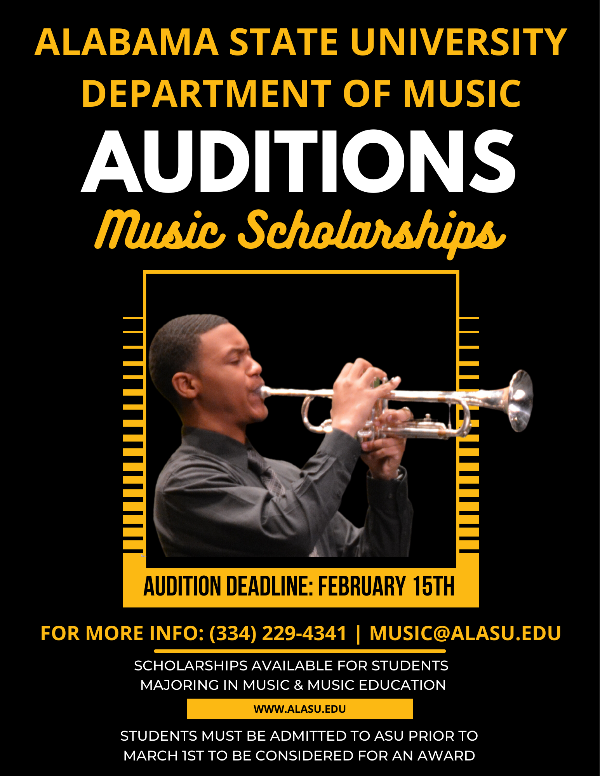
The Department of Music holds auditions each spring for prospective students who wish to audition for a scholarship. For Music Majors, the audition provides admission into the Bachelor of Arts in Music or the Music Education degree program, and allows for students to be considered for competitive performance-based talent scholarship awards from the Department of Music and for competitive performance-based ensemble awards for the Marching Band, Wind Ensemble, and University Choir. For Non-Music Majors, the audition allows for students to be considered for competitive performance-based ensemble awards for the Marching Band, Wind Ensemble, and University Choir.
Prospective students must complete the following steps in order to be eligible for a Music Major, Marching Band, Wind Ensemble, or Choir scholarship award from the Department of Music:
- Complete and submit an online ASU Undergraduate Admissions Application
- Submit a copy of the high school transcript and ACT/SAT test scores to the ASU Admissions Office
- Fill out the following Department of Music Scholarship Interest Form
- Submit an audition video on the Department of Music Audition Website or contact the ASU Music Office at (334) 229-4341 or at music@alasu.edu, to schedule a live, in-person audition during a campus visit. To be considered for a priority scholarship award, students must complete an audition or submit an audition video prior to February 15th. Instrumental students may do their live, in-person audition while visiting campus during Honor Band in February.
- Only students who have been fully admitted to the University prior to February 15th will be eligible to audition and to receive a scholarship award offer from ASU. Notifications of scholarship awards will be sent to students after the completion of auditions in February.
- Late auditions may be submitted or completed in March and April, however, prospective students are strongly encouraged to submit or complete their auditions prior to February 15th as scholarship funds may or may not be available after the first round of priority offers are sent out at the end of February. Any additional awards offered in March or April will be made pending the availability of scholarship funds.
Audition Materials
ASU music faculty members are available to answer any questions or concerns you may have about the audition process. In addition to the suggested repertoire outlined below, each student will be asked to sight-read and to answer basic music theory questions during the audition.
|
VOICE |
Mr. Tyrone Hayes |
(334) 604-9305 |
|
|
Musical selection(s): FROM MEMORY
|
|||
|
PIANO |
Dr. Adonis Gonzalez |
(334) 604-9190 |
|
|
|||
|
FLUTE |
Dr. Michael Westmoreland |
(334) 604-9306 |
|
Non-Music Majors interested in a Marching Band or Wind Ensemble scholarship only, may substitute the Alabama or Georgia All-State Etudes for the etudes listed above. |
|||
| OBOE |
Dr. Michael Westmoreland |
(334) 604-9306 |
|
All selections are from David Hite’s book Melodious and Progressive Studies for Oboe, Book 1.
page 10 Number 17 (F Major); page 11 Number 18 (D Minor); page 13 Number 2 (A Minor)
Page 2 Number 3 (G Major); Page 20 Number 9 (Ab Major) – beginning through m. 16 Non-Music Majors interested in a Marching Band or Wind Ensemble scholarship only, may substitute the Alabama or Georgia All-State Etudes for the etudes listed above. |
|||
|
BASSOON |
Dr. Michael Westmoreland |
(334) 604-9306 |
|
All selections are from J. Weissenborn’s Practical Method for the Bassoon.
Page 88 – Number 14 (F Major) – beginning through measure 16.
Page 38 – Section XVII, 3rd excerpt on page (Andante, 26 measures long) Non-Music Majors interested in a Marching Band or Wind Ensemble scholarship only, may substitute the Alabama or Georgia All-State Etudes for the etudes listed above. |
|||
|
CLARINET |
Dr. Katrina Phillips |
(334) 604-8201 |
|
All selections are from David Hite’s book Melodious and Progressive Studies for Clarinet, Book 1.
page 10 Number 17 (F Major); page 11 Number 18 (D Minor); page 13 Number 2 (A Minor)
Page 2 Number 3 (G Major); Page 20 Number 9 (Ab Major) – beginning through m. 16. Non-Music Majors interested in a Marching Band or Wind Ensemble scholarship only, may substitute the Alabama or Georgia All-State Etudes for the etudes listed above. |
|||
|
SAXOPHONE |
Dr. Michael Westmoreland |
(334) 604-9306 |
|
All selections are from David Hite’s book Melodious and Progressive Studies for Saxophone, Book 1.
page 10 Number 17 (F Major); page 11 Number 18 (D Minor); page 13 Number 2 (A Minor)
Page 2 Number 3 (G Major); Page 20 Number 9 (Ab Major) – beginning through m.16. Non-Music Majors interested in a Marching Band or Wind Ensemble scholarship only, may substitute the Alabama or Georgia All-State Etudes for the etudes listed above. |
|||
|
TRUMPET |
Dr. Carly Johnson |
(334) 229-4341 |
|
Non-Music Majors interested in a Marching Band or Wind Ensemble scholarship only, may substitute the Alabama or Georgia All-State Etudes for the etudes listed above. |
|||
|
FRENCH HORN |
Dr. Brenda Luchsinger |
(334) 604-9140 |
|
Non-Music Majors interested in a Marching Band or Wind Ensemble scholarship only, may substitute the Alabama or Georgia All-State Etudes for the etudes listed above. |
|||
|
TROMBONE & EUPHONIUM |
Dr. Jonathan Houghtling |
(334) 604-8415 |
|
|
Trombone & Euphonium (bass clef)
Euphonium (treble clef): refer to trumpet requirements Non-Music Majors interested in a Marching Band or Wind Ensemble scholarship only, may substitute the Alabama or Georgia All-State Etudes for the etudes listed above. |
|||
|
TUBA |
Dr. Jonathan Houghtling |
(334) 604-8415 |
|
Non-Music Majors interested in a Marching Band or Wind Ensemble scholarship only, may substitute the Alabama or Georgia All-State Etudes for the etudes listed above. |
|||
|
PERCUSSION |
Dr. Jessica Williams |
(334) 604-8414 |
|
To be considered for a Music Major scholarship, students must demonstrate their skills and proficiency on snare drum, mallet percussion, and timpani. Non-Music Majors interested in a Marching Band or Wind Ensemble scholarship only, may substitute the Alabama or Georgia All-State Etudes for the etudes listed above. |
|||

Take the Next Steps
Greatness starts with a single step. Explore Alabama State University, schedule a visit, apply for admission, support our mission, or find new ways to engage with the Hive.